Running a small business is not always easy. From answering customers to creating content, managing tasks, checking data, and promoting products, there are many things that need attention every day. In my experience, one of the biggest challenges for a small business owner is trying to do everything with limited time and resources.
This is where AI tools can make a real difference.
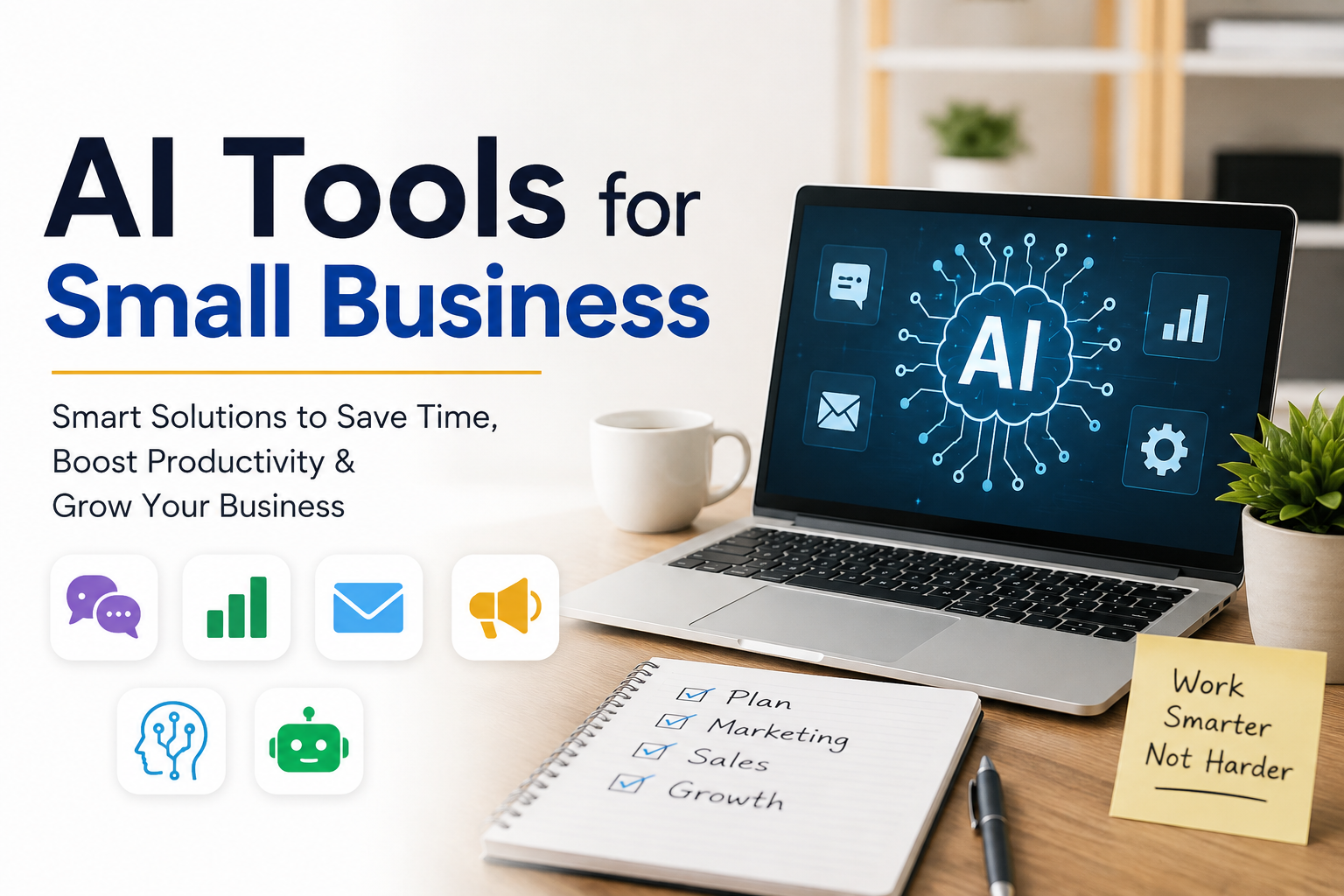
Artificial intelligence is no longer something that only large companies can use. Today, small businesses can use AI tools to save time, improve productivity, create better content, communicate with customers, and make smarter decisions. I believe AI is especially useful for small businesses because it can help one person handle tasks that might otherwise require a whole team.
In this article, I will share my thoughts about AI tools for small businesses, how they can be used, and why I think they are becoming an important part of modern business.
Why Small Businesses Need AI Tools
Small businesses usually have fewer employees and smaller budgets than large companies. Because of this, business owners often have to manage several responsibilities at the same time.
One day you might be working on marketing, while the next day you may need to answer customer questions, prepare a report, or update your website. Doing all of these tasks manually can take a lot of time.
I think the biggest advantage of AI is not simply automation. It is the ability to give business owners more time to focus on important work.
For example, an AI writing tool can help create a first draft of a blog post. An AI design tool can help create social media graphics. An AI assistant can organize information or help write emails. These small improvements can save hours over the course of a week.
AI Writing Tools
Content is important for almost every modern business. Websites need articles, social media accounts need posts, emails need to be written, and product descriptions need to be updated.
AI writing tools can help with many of these tasks.
I personally think AI writing tools are most useful when they are treated as assistants rather than replacements for human writers. Instead of asking AI to create everything and publishing it immediately, I prefer the idea of using AI to develop ideas, organize thoughts, create outlines, and improve existing writing.
A small business owner can use an AI writing tool to create blog ideas, product descriptions, email drafts, social media captions, advertisements, and frequently asked questions.
The final content should still be reviewed by a human. Adding personal experience and real business information makes the content more natural and useful.
AI Customer Support Tools
Customer service can take a lot of time, especially for businesses that receive similar questions every day.
AI powered customer support tools can help answer common questions automatically. For example, customers may ask about opening hours, shipping information, product availability, payment methods, or return policies.
An AI chatbot can provide quick answers to these common questions. If a customer has a complicated problem, the conversation can then be transferred to a human employee.
I think this is one of the most practical uses of AI for a small business. Customers often want quick answers, and business owners do not always have time to respond immediately.
A good AI customer support system can provide basic assistance while allowing the business owner to focus on more important tasks.
AI Tools for Marketing
Marketing can be expensive when a small business has a limited budget. AI tools can make many marketing activities easier and more affordable.
For example, AI can help generate ideas for social media campaigns, write advertising copy, suggest content topics, analyze customer behavior, and create marketing plans.
A small business owner can also use AI to understand which types of content may be more useful for their audience.
I would not depend completely on AI for marketing decisions, because every business has a different audience. However, AI can provide ideas that help business owners think of possibilities they may not have considered.
For me, the best approach is to combine AI suggestions with personal knowledge about customers.
AI Design Tools
Professional design can be expensive, especially for a new business. Hiring a designer for every social media post, presentation, banner, or promotional image may not be practical.
AI design tools can help small businesses create visual content much faster.
They can be used for social media graphics, presentations, advertisements, website images, promotional materials, and other basic designs.
Even someone without advanced design skills can use these tools to create something presentable.
I think AI design tools are particularly useful for small businesses that are just getting started. They allow owners to experiment with different ideas without spending a large amount of money on every design.
At the same time, businesses should make sure that their images and designs follow copyright rules and do not copy another company’s branding.
AI Tools for Social Media
Social media is one of the easiest ways for a small business to reach potential customers, but managing several social platforms can become time consuming.
AI can help create content calendars, generate post ideas, write captions, suggest hashtags, and organize publishing schedules.
For example, a local business could ask AI to suggest a month’s worth of social media ideas. The owner can then choose the ideas that actually match the business.
I believe this can remove one of the biggest problems with social media marketing, which is not knowing what to post.
AI can provide a starting point, but businesses should still add their own personality. Customers usually respond better to content that feels real rather than content that sounds completely automated.
AI Tools for Data Analysis
Data can help businesses make better decisions, but many small business owners do not have time to study complicated spreadsheets.
AI data analysis tools can make information easier to understand.
A business owner might use AI to analyze sales numbers, identify popular products, compare monthly performance, or find unusual changes in business data.
For example, if sales suddenly decrease in one product category, AI may help identify the change quickly. The owner can then investigate the reason.
I think this is especially valuable because small businesses need to make decisions based on real information. AI can help turn complicated data into simple explanations.
However, important financial decisions should always be checked carefully. AI can make mistakes, so business owners should not blindly trust every result.
AI Tools for Email and Communication
Email is still an important part of business communication. Small business owners may spend a significant amount of time writing emails to customers, suppliers, employees, and business partners.
AI can help write professional emails, improve grammar, summarize long messages, and create quick responses.
This does not mean every email should sound like it was written by a machine. I think AI works best when it creates a draft and the business owner adds personal details before sending it.
For example, instead of spending fifteen minutes writing a customer response, AI can create a basic draft in a few seconds. The owner can then review it and make it sound more personal.
That small time saving can become significant when a business sends dozens of emails every week.
AI Tools for Productivity
Productivity is another area where AI can help small businesses.
AI assistants can help create task lists, summarize meetings, organize notes, prepare schedules, and turn ideas into action plans.
Imagine having a long meeting with several important points. Instead of manually writing everything down and creating a summary, an AI tool can help organize the information.
AI can also help break a large project into smaller tasks. This can make business work feel more manageable.
In my opinion, productivity tools are most useful when they reduce unnecessary work instead of simply adding another complicated system to the business.
AI for Financial Management
Money management is extremely important for small businesses. AI based financial tools can help organize expenses, categorize transactions, create reports, and identify spending patterns.
Some tools can also help with invoices and payment reminders.
This can make financial administration easier, especially for business owners who do not have a large accounting department.
However, I would be careful when using AI for financial matters. Important tax, accounting, and legal decisions should be reviewed by a qualified professional when necessary.
AI can assist with organization and understanding, but it should not replace professional advice.
Choosing the Right AI Tools
There are thousands of AI tools available today, and this can actually create another problem. Small business owners may waste time trying too many tools.
I think it is better to start with a specific problem.
For example, if writing content takes too long, look for an AI writing assistant. If customer questions take too much time, consider an AI customer support tool. If creating graphics is difficult, try an AI design platform.
There is no need to use AI everywhere.
The best tools are the ones that solve real problems and save meaningful amounts of time.
Before choosing a tool, I would also check its pricing, privacy policies, features, integrations, and ease of use. A cheap tool is not always useful, and an expensive tool is not automatically better.
Things Small Businesses Should Remember
AI has many benefits, but it also has limitations.
AI can sometimes provide incorrect information. It can misunderstand instructions, produce generic content, or make recommendations that do not fit a particular business.
This is why human review is important.
Businesses should also be careful about entering private customer information, financial details, passwords, or other sensitive data into AI systems unless the service provides appropriate security and privacy protections.
Another important point is originality. If a business uses AI to create content, it should add its own knowledge, experience, examples, and opinions.
That is what makes a business different from thousands of other businesses using similar tools.
My Final Thoughts
I believe AI tools can be extremely helpful for small businesses when they are used in the right way.
They can save time, reduce repetitive work, support marketing, improve customer communication, assist with content creation, and help business owners understand their data.
But I do not think AI should completely control a business.
The human side of business still matters. Customers want genuine communication. Businesses need creativity, judgment, trust, and personal relationships. AI can support these things, but it cannot replace the value of understanding your customers and knowing your own business.
For me, the best way to use AI is simple. I would use it for tasks that take too much time, repetitive activities that do not require much human judgment, and situations where I need help getting started.
Small businesses do not need dozens of AI tools. They need a few useful tools that solve real problems.
If AI is used thoughtfully, even a small business with a limited team can work faster, stay organized, and compete more effectively. That is why I think learning how to use AI is becoming just as important as learning traditional business skills.