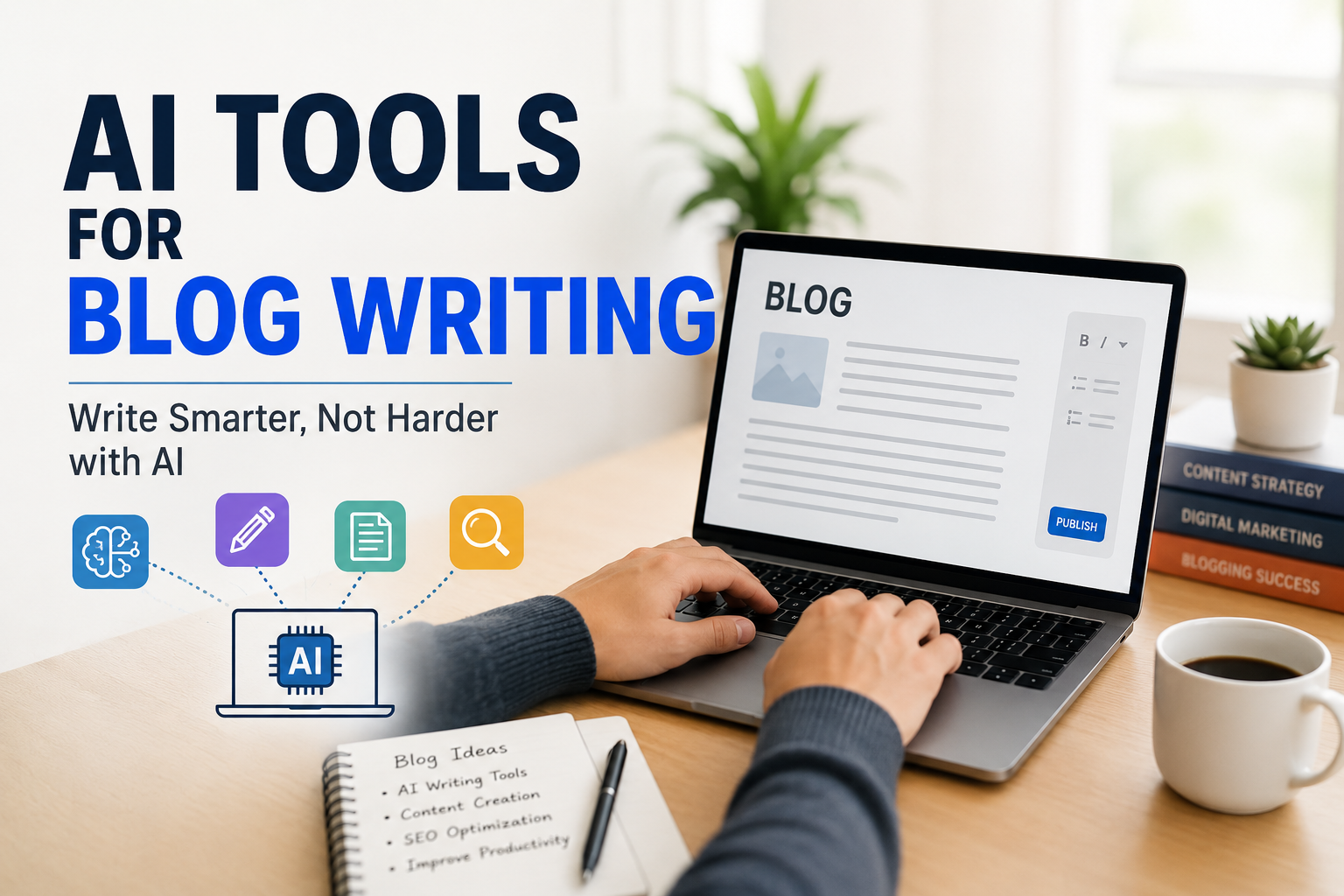
Writing a blog post can look easy from the outside, but anyone who has written consistently knows that it takes time and effort. Finding ideas, researching topics, creating an outline, writing paragraphs, checking grammar, and making the content useful for readers can take several hours.
In my experience, this is where AI tools for blog writing can make a big difference. I do not see AI as a complete replacement for a human writer. Instead, I see it as a helpful assistant that can make the writing process faster and more organized.
There are now many AI tools available for bloggers. Some can help with research and ideas, while others can help with writing, editing, grammar, headlines, and search engine optimization. The important thing is knowing how to use these tools properly.
In this article, I will explain how AI tools can help with blog writing and how I personally think bloggers should use them.
What Are AI Tools for Blog Writing?
AI tools for blog writing are software applications that use artificial intelligence to help people create and improve written content. These tools can understand written instructions and generate text based on the information provided by the user.
For example, I can give an AI writing tool a topic such as “how to save money every month” and ask it to create an outline. It may suggest sections such as budgeting, reducing unnecessary expenses, cooking at home, and tracking spending.
This does not mean I should publish everything the tool creates without checking it. I prefer to use AI as a starting point. I add my own ideas, experiences, examples, and opinions to make the article more personal.
Why I Think AI Is Useful for Bloggers
The biggest advantage of AI writing tools is saving time. When I start writing an article from a blank page, the first few paragraphs can sometimes be difficult. I may know what I want to say but struggle to organize my thoughts.
AI can help me overcome that problem by giving me a basic structure.
Another advantage is idea generation. Bloggers often experience writer’s block. After writing many articles about similar subjects, finding a fresh angle can become difficult. AI can suggest different approaches and questions that readers may have.
AI can also help with editing. Even when I write an article myself, I may miss grammar mistakes or awkward sentences. An AI editor can point out areas that need improvement.
For me, the best use of AI is not simply producing more words. It is making the entire writing process easier.
AI Tools for Finding Blog Ideas
One of the first steps in blogging is finding good topics. A successful blog needs content that people actually want to read.
AI tools can help generate topic ideas based on a specific niche. For example, if I have a personal finance blog, I can ask AI for beginner friendly topics about saving money, budgeting, investing, or managing expenses.
I can also ask for questions that beginners commonly have about a topic. These questions can become individual blog posts.
The important thing is to avoid creating random articles just because an AI tool suggested them. I always think about whether the topic is genuinely useful to my target audience.
A good blog idea should solve a problem, answer a question, explain something clearly, or provide practical information.
AI Tools for Creating Blog Outlines
I personally find AI particularly useful for creating outlines.
Before writing a long article, I like to know what points I want to cover. An outline gives the article a logical structure and helps prevent unnecessary repetition.
For example, an article about AI tools for small businesses could include sections about customer service, marketing, accounting, productivity, content creation, and choosing the right tool.
Once I have an outline, I can decide which sections need more personal explanation and which ones require additional research.
An outline also makes writing less stressful because I am no longer staring at an empty page.
AI Tools for Writing First Drafts
AI writing tools can create a first draft from a topic and some instructions. This can be useful when I need to understand how an article might be structured.
However, I believe bloggers should be careful here.
A completely AI generated article can sometimes sound repetitive or generic. It may contain information that is outdated, inaccurate, or too broad. That is why I would never recommend publishing an AI generated draft without reviewing it.
I prefer to treat the AI draft as raw material. I read it carefully, remove unnecessary parts, add my own opinions, change the wording, and include useful examples.
The final article should sound like it was written for real people, not simply generated by software.
AI Tools for Improving Grammar
Grammar and readability are important for every blog. Even a great idea can become difficult to understand if the writing is full of mistakes.
AI grammar tools can help identify spelling problems, unclear sentences, repeated words, and other writing issues.
I find these tools especially useful when I have written a long article. Reading the same text several times can make it difficult to notice small mistakes.
An AI editor can provide another perspective.
Still, I do not accept every suggestion automatically. Sometimes an AI tool may recommend changing a sentence that is perfectly fine. As the writer, I make the final decision.
AI Tools for Creating Better Headlines
A headline is one of the most important parts of a blog post. It is usually the first thing a reader sees.
AI can generate several headline ideas for the same topic. For example, instead of using a basic title such as “Ways to Save Money,” I might ask AI for more specific options.
It could suggest titles focused on saving money each month, saving money on a low income, or reaching a specific savings goal.
I then choose a headline that accurately represents the article. I do not believe in using misleading headlines simply to get clicks.
A good headline should create interest while honestly telling readers what they will find inside the article.
AI Tools for Search Engine Optimization
Search engine optimization is another area where AI tools can help bloggers.
AI can suggest related keywords, questions, headings, title ideas, and content topics. It can also help identify areas that may be missing from an article.
For example, if I am writing about blog writing tools, I might ask AI to suggest related questions that beginners could search for. These questions can help me create a more complete article.
However, I believe SEO should never become more important than the reader.
Writing an article by repeatedly inserting keywords can make the content unnatural. I prefer to use keywords naturally while focusing on providing genuine value.
Search engines are designed to help people find useful information, so the reader should always come first.
AI Tools for Research Assistance
Research is an important part of quality blogging. AI can help me understand complicated subjects, generate research questions, and organize information.
However, I do not consider AI itself to be a perfect research source.
When an article includes important facts, statistics, product information, prices, or current developments, I prefer to verify those details using reliable sources.
This is especially important because AI can sometimes produce information that sounds confident but is incorrect.
Using AI for research assistance is useful, but fact checking remains the responsibility of the writer.
How I Would Use AI in My Blogging Workflow
If I were starting a new blog today, I would use AI at several stages of my writing process.
First, I would choose a topic based on my audience. Then I would use AI to brainstorm related questions and possible angles.
Next, I would create an outline and decide what information should be included.
After that, I might use AI to help create a rough first draft. I would then rewrite the draft in my own style and add personal examples.
Once the article is complete, I would use an AI editing tool to check grammar, clarity, and readability.
Finally, I would review the entire article myself. I would verify important facts and make sure the content actually answers the reader’s question.
This workflow allows AI to save time without taking away the human part of blogging.
Mistakes Bloggers Should Avoid With AI
One of the biggest mistakes is publishing AI generated content without reading it.
Another mistake is relying on AI for facts without verification. AI tools can make mistakes, so important information should always be checked.
Some bloggers also use AI to create hundreds of articles without thinking about quality. I do not think this is a good long term strategy.
A successful blog is built around useful content and trust. Publishing large amounts of low quality content may save time initially, but it does not necessarily create a valuable website.
I also believe bloggers should avoid copying the same AI generated style for every article. Readers appreciate content that feels natural and unique.
Can AI Replace Human Bloggers?
In my opinion, AI can replace some writing tasks, but it cannot completely replace a good human blogger.
A human writer understands personal experiences, emotions, opinions, and the needs of a specific audience in a different way.
For example, I can write about something I personally experienced and explain what worked for me and what did not. AI can help me organize that experience, but the experience itself comes from me.
That is why I see AI as a writing assistant rather than a replacement for human creativity.
Final Thoughts
AI tools for blog writing have changed the way many people create content. They can help with ideas, outlines, drafts, grammar, headlines, SEO, and research assistance.
For me, the most useful approach is to combine AI with human judgment.
AI can help me get started when I am stuck. It can save time during editing and help me organize complicated ideas. But I still need to provide the personality, experience, opinions, and final judgment.
If you are a blogger, I think AI is worth learning. You do not need to use it for everything. Start with one part of your writing process and see whether it genuinely saves you time.
The goal should not be to publish as many articles as possible. The goal should be to create useful content that real people enjoy reading and find helpful.
When AI and human creativity are used together, blogging can become faster, more organized, and more enjoyable without losing the personal touch that makes a good blog different from ordinary content.