
When I first started learning SEO content writing, I thought the most important thing was simply using the right keywords. Later, I realized that SEO is much bigger than keywords. Good SEO content needs to be useful, easy to understand, well organized, and written for real people. This is where AI tools have become very helpful for me.
AI tools for SEO content can save a lot of time during research, writing, editing, optimization, and content planning. They do not completely replace human writers. In my opinion, the best results come when I use AI as an assistant instead of depending on it to do everything.
There are many AI tools available today, and each one can help with a different part of the content creation process. Some help with keyword research, some help generate ideas, while others can improve readability and optimize content for search engines.
In this article, I will share how I look at AI tools for SEO content and how beginners can use them in a practical way.
What Are AI Tools for SEO Content?
AI SEO content tools are software applications that use artificial intelligence to help create and improve content for search engines. They can analyze topics, suggest keywords, create outlines, generate drafts, improve sentences, and identify areas where content can be stronger.
For me, the biggest advantage is speed. Normally, researching a topic and creating a detailed article can take several hours. With the right AI tools, I can complete the research and planning much faster.
However, I never think of AI generated text as a finished article. I prefer to use the output as a starting point. I add my own ideas, examples, opinions, and experiences so the final article feels more natural.
AI Tools for Keyword Research
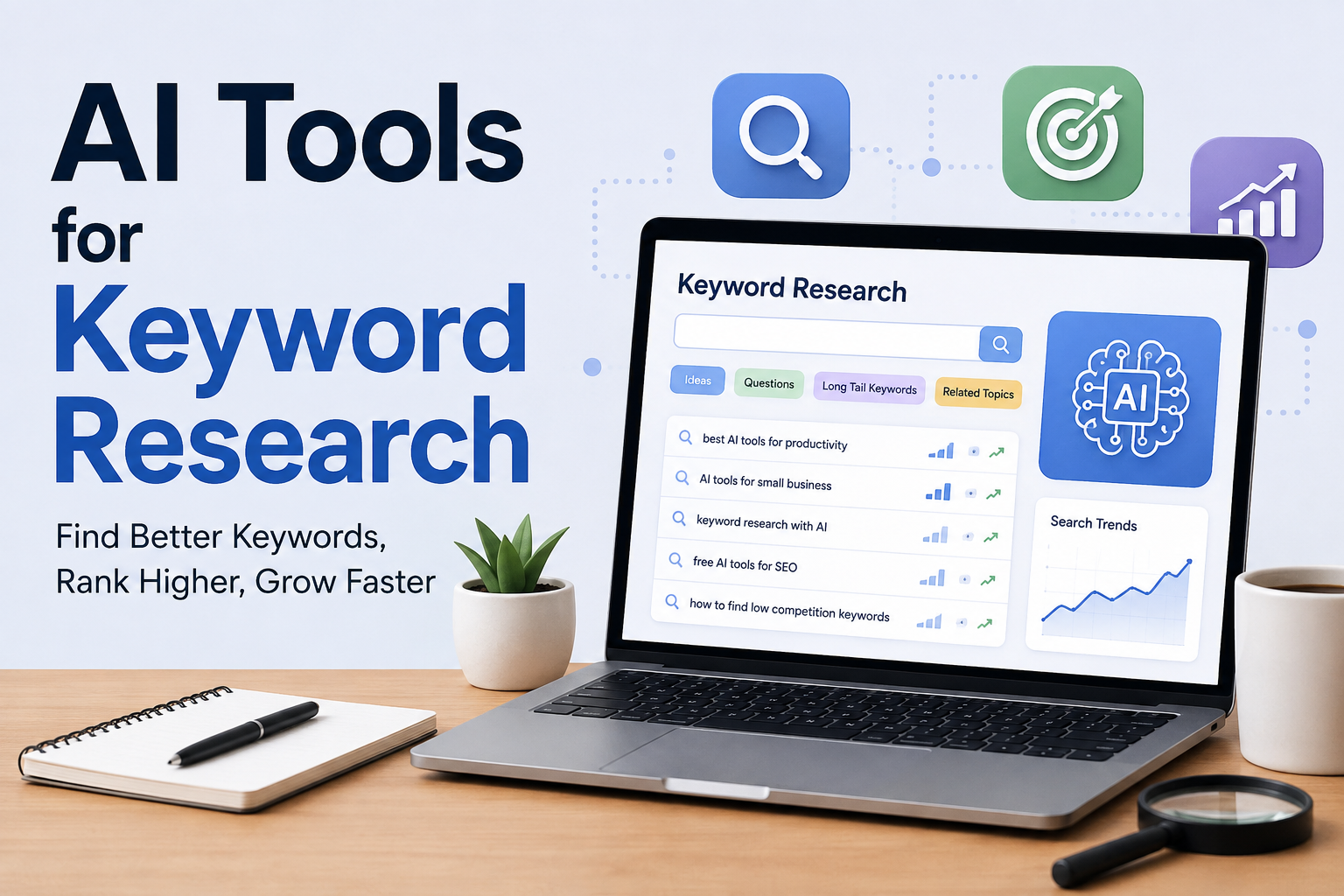
Keyword research is one of the first steps in creating SEO content. Before writing an article, I want to understand what people are actually searching for.
AI powered keyword tools can help generate related search terms and topic ideas. Instead of focusing on one keyword, I can discover different questions and phrases connected to the main topic.
For example, if I want to write about SEO content, I might start with a phrase like AI SEO tools. From there, an AI tool can help me think of related topics such as AI tools for keyword research, AI content optimization, SEO writing tools, content planning tools, and AI writing assistants.
This gives me a wider view of the topic.
I also find keyword tools useful for finding long tail keywords. These keywords usually have more words and are often more specific. They can be useful for creating articles that answer particular questions.
Still, I do not blindly use every keyword suggested by an AI tool. I check whether the keyword actually makes sense for my article and whether it matches the search intent.
AI Tools for Content Ideas
One problem I often face as a writer is deciding what to write about next. Sometimes I have a general topic in mind but cannot find enough ideas to turn it into a complete content plan.
This is another area where AI can help.
I can give an AI tool a broad subject and ask it to suggest article ideas. It can provide questions, subtopics, comparisons, guides, and beginner friendly topics.
For example, a website about digital marketing could create articles around SEO basics, keyword research, content marketing, technical SEO, link building, local SEO, and AI SEO tools.
The important thing is that I do not simply publish every idea the AI gives me. I choose topics based on my website audience and the information I can actually provide.
I believe this makes the content strategy much more useful.
AI Tools for Creating Content Outlines
Before writing a long article, I usually prefer creating an outline. It helps me organize my thoughts and makes the writing process easier.
AI can create a basic outline within seconds. I can ask it to structure an article with an introduction, main sections, examples, tips, and conclusion.
For SEO content, a good outline is especially useful because it helps cover a topic properly. Instead of repeating the same information, I can divide the article into clear sections.
For example, an article about AI SEO tools could include what AI SEO tools are, why they are useful, keyword research, content creation, optimization, common mistakes, and practical tips.
After getting the outline, I usually change it according to my own ideas. I want the article to have a natural flow rather than looking like something automatically generated.
AI Writing Assistants
AI writing assistants are probably the most popular type of AI content tool.
They can help create introductions, paragraphs, explanations, summaries, and even complete drafts. For someone who struggles with writing, this can be very useful.
Personally, I think AI writing assistants are best when I am stuck. Sometimes I know what I want to say but cannot find the right words. AI can provide a starting point that I can then rewrite in my own style.
I also use AI to simplify complicated sentences. If a paragraph sounds too formal or difficult, an AI assistant can suggest a more natural version.
But I would not recommend publishing AI generated content without reviewing it. AI can sometimes provide incorrect information, repeat ideas, or use language that feels unnatural.
Human editing is still very important.
AI Tools for Improving Readability
SEO content should not only be optimized for search engines. It should also be easy for readers to understand.
When I write a long article, I try to use short paragraphs, clear headings, simple sentences, and useful examples. AI tools can help identify sentences that are too complicated.
They can also suggest better wording and improve grammar.
This is particularly useful when English is not your first language. An AI writing assistant can help make your writing sound clearer while allowing you to keep your original ideas.
I think readability is one of the areas where AI can be genuinely helpful because the goal is not simply to rank on Google. The goal is to make visitors stay on the page and actually read the content.
AI Tools for SEO Content Optimization
After writing an article, I usually look at optimization. This includes checking the title, headings, keyword usage, internal links, readability, and overall topic coverage.
AI SEO tools can analyze content and suggest areas for improvement.
For example, an AI tool may tell me that an article does not cover an important subtopic. It might also suggest related terms that could make the content more complete.
I find this useful because sometimes I become too focused on the main topic and forget smaller questions readers may have.
However, I do not try to insert every suggested keyword into an article. Keyword stuffing can make content difficult to read.
My goal is always to use keywords naturally.
AI Tools for Creating SEO Titles
The title is one of the first things a reader sees, so I take it seriously.
AI tools can generate several title ideas based on a topic. This is useful when I have written an article but cannot decide on the best headline.
For example, instead of using a basic title such as AI SEO Tools, I might consider something more specific like AI Tools for SEO Content: A Practical Guide for Beginners.
I prefer titles that clearly explain what the reader will get from the article. I also avoid making unrealistic promises just to attract clicks.
A good title should create interest while honestly representing the content.
AI Tools for Meta Descriptions
Meta descriptions are another part of SEO where AI can save time.
I can provide the article topic and ask an AI tool to suggest several meta descriptions. Then I choose one and edit it if necessary.
The description should explain what the page is about and encourage the searcher to learn more.
I do not treat AI suggestions as final. I always make sure the description accurately represents the article.
AI Tools for Content Refreshing
One of my favorite uses of AI is updating older content.
Websites often have articles that were published months or years ago. Some information may become outdated, while other sections may need better explanations.
AI can help identify areas that need improvement. I can ask it to summarize the existing article, suggest missing sections, or provide ideas for making the content more useful.
After that, I manually verify important information before making changes.
This process can be much faster than rewriting an old article from scratch.
The Importance of Human Experience
Even though AI has become very powerful, I still believe human experience is extremely important in SEO content.
AI can produce information, but it does not have my personal experiences. It does not know exactly what I have learned from working on websites, writing content, researching topics, or making mistakes.
This is why I like adding personal observations to my articles.
For example, instead of simply saying that keyword research is important, I can explain how I personally approach keyword research and what mistakes I try to avoid.
These details make an article feel more genuine.
Common Mistakes When Using AI for SEO Content
There are several mistakes I think beginners should avoid.
The first mistake is publishing everything AI generates without editing it. This can result in repetitive and generic content.
The second mistake is relying completely on AI for factual information. AI can make mistakes, so important facts should be checked.
The third mistake is focusing too much on keywords. SEO is not about putting the same phrase into every paragraph.
Another mistake is forgetting the reader. An article should answer a real question or solve a real problem.
Finally, I would avoid making every article sound exactly the same. Adding personal opinions, examples, stories, and practical advice can make content much more interesting.
How I Would Use AI for SEO Content
If I were starting today, I would keep my process simple.
First, I would choose a topic that is relevant to my website.
Then I would use AI tools to generate related questions and keyword ideas. After that, I would create an outline and decide which points I personally want to discuss.
Next, I would write the article using AI only when I need help with research, structure, or wording.
After writing, I would edit everything carefully. I would remove unnecessary sentences, add personal examples, improve headings, and check important information.
Finally, I would optimize the article for SEO while making sure it still sounds natural.
This approach gives me the benefits of AI without losing the human side of writing.
Final Thoughts
AI tools for SEO content have changed the way I approach content creation. They can save time, generate ideas, improve writing, help with optimization, and make content planning easier.
But I do not believe AI should replace the writer.
The strongest SEO content, in my opinion, comes from combining AI assistance with human knowledge and experience. AI can help me work faster, but my judgment decides what information is useful, what should be included, and how the article should speak to readers.
If you are a beginner, you do not need dozens of expensive tools. Start with a few useful AI tools and learn how to use them properly. Focus on creating content that answers questions, provides real value, and feels natural to read.
For me, that is the real purpose of using AI for SEO. It is not about producing more content as quickly as possible. It is about using technology to make the content creation process smarter while keeping the human voice at the center.