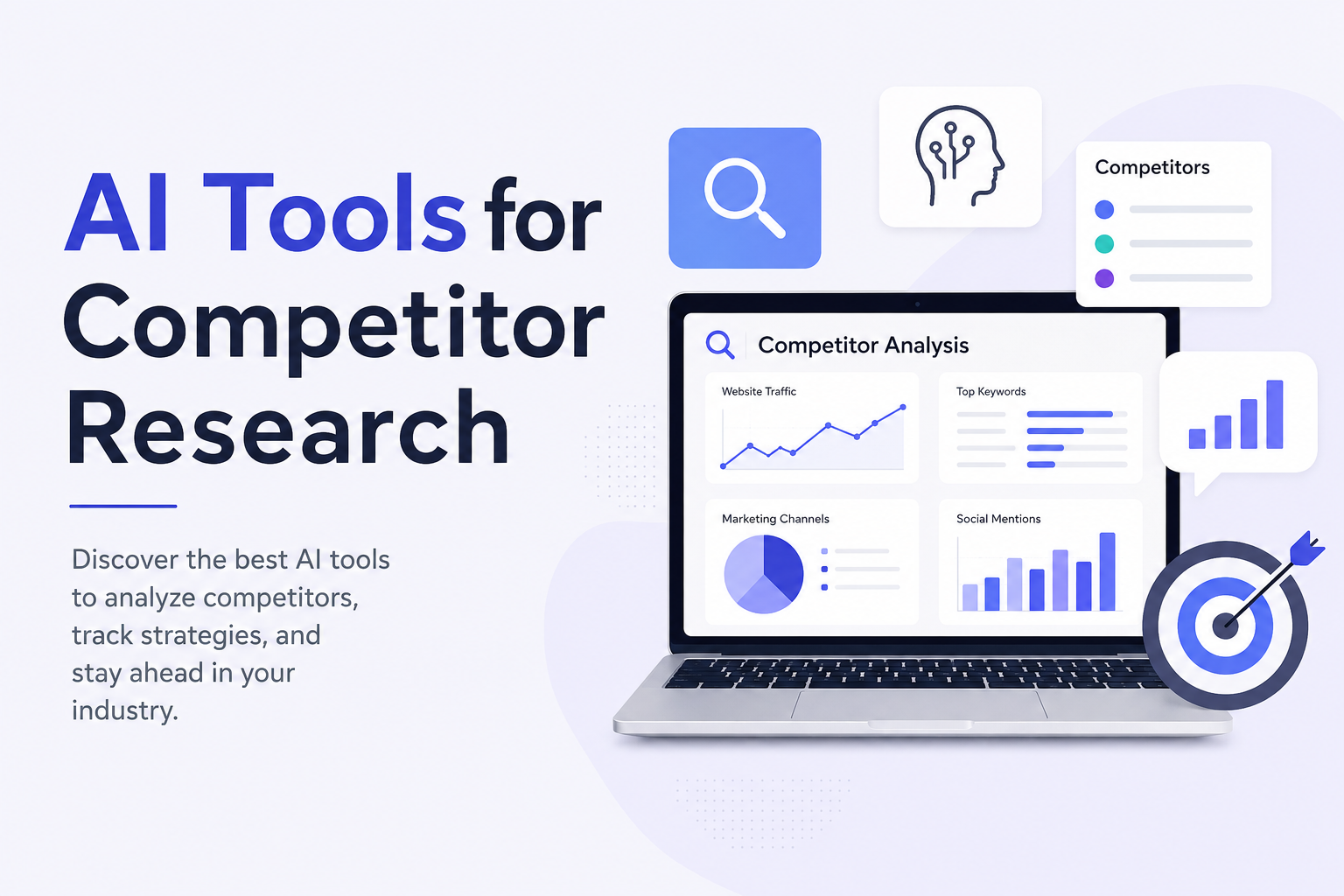
When I started working on websites and online content, I thought competitor research was mostly about searching Google, checking a few websites, and trying to understand what other people were doing. With time, I realized that competitor research is much more than that. If I want my website or business to grow, I need to understand who I am competing with, what they are doing well, where they are weak, and what opportunities they may be missing.
This is where AI tools for competitor research have become very useful for me.
AI can save a lot of time when I need to collect information, compare websites, find content ideas, study keywords, or understand what makes another website successful. Instead of spending hours going through everything manually, I can use AI to organize information and give me a clearer starting point.
In my opinion, AI should not completely replace human research. I see it more as a research assistant. It helps me find patterns and ideas faster, while I still make the final decisions.
What Is Competitor Research?
Competitor research means studying businesses, websites, creators, or brands that are targeting a similar audience.
For example, if I have a website about digital marketing, I can look at other websites that publish articles about SEO, content marketing, social media, and AI tools. I can study the topics they cover, the keywords they target, the type of content they publish, and the way they attract visitors.
Competitor research helps me answer important questions.
What topics are competitors writing about?
Which keywords are they targeting?
What type of content gets attention?
What are they doing better than me?
Where are there gaps that I can take advantage of?
What can I do differently?
These questions can help me create a better strategy instead of simply guessing what might work.
Why I Like Using AI for Competitor Research
The biggest advantage I have noticed is speed.
Manual research can take a huge amount of time. If I want to study five or ten competitors, I may need to visit their websites, check their articles, compare their keywords, look at their social media activity, and take notes.
AI can help organize this process.
I can give an AI tool information about several competitors and ask it to compare their strengths, weaknesses, topics, and content strategies. This gives me a useful overview much faster.
Another thing I like is that AI can help me notice patterns. Sometimes I may look at several competitor websites and not immediately realize that they are all targeting similar topics. AI can help group these topics and make the pattern easier to understand.
AI Tools for Finding Competitor Keywords
One of the most important parts of competitor research for me is keyword research.
Competitors can give me a lot of ideas about what people are searching for. If another website is ranking for keywords related to my topic, I want to know what those keywords are and whether there are opportunities for me.
Tools such as Semrush, Ahrefs, and similar SEO platforms can help with competitor keyword analysis. AI features can make the process easier by helping organize keywords, identify related topics, and suggest content opportunities.
For example, if I find that a competitor is getting traffic from articles about beginner SEO tools, I can investigate related searches and create my own useful content around the topic.
I do not believe in simply copying competitor keywords. Instead, I use competitor data as inspiration. My goal is to understand what the audience wants and then create something more useful and original.
AI Tools for Competitor Content Analysis
Content analysis is another area where AI can save me a lot of time.
When I study a competitor, I want to know what kind of content they are publishing. Are they writing long guides? Are they publishing short articles? Are they creating comparison posts? Are they using tutorials, lists, case studies, or product reviews?
AI can help categorize this content.
For example, I can collect the titles of several competitor articles and ask an AI tool to identify common topics and patterns. It can help me understand which subjects appear frequently and which subjects seem to be ignored.
This can lead to new content ideas.
Sometimes the best opportunity is not writing about exactly what everyone else is writing about. It can be finding a related question that competitors have not answered properly.
AI for Finding Content Gaps
Content gaps are extremely valuable when I am researching competitors.
A content gap is basically a topic or question that the audience needs but competitors are not covering well.
Imagine that five websites have articles about AI writing tools. Most of them may discuss features, pricing, and general benefits. However, perhaps none of them explains how beginners can use these tools for a specific type of work.
That missing information can become an opportunity.
AI can help compare competitor content and identify areas that appear to be missing. I still like to verify these gaps myself because AI can sometimes misunderstand information. However, it can give me a strong starting point.
In my experience, finding a good content gap can be more valuable than simply trying to copy a competitor’s successful article.
AI for Competitor Website Analysis
I also use AI to think about the overall structure of competitor websites.
A website is not only about articles. Its navigation, categories, landing pages, product pages, internal links, and calls to action all matter.
When studying a competitor, I can look at how their website is organized and ask AI to help me understand the structure.
For example, I might notice that a competitor has separate sections for beginner guides, advanced tutorials, software reviews, and industry news.
That tells me something about how they are targeting different types of visitors.
I can then think about whether a similar structure would make sense for my own website.
The important thing is not to copy the website. I use the research to understand how successful websites organize information.
AI for Competitor Social Media Research
Competitor research should not stop at Google.
Social media can reveal a lot about what audiences are interested in. AI can help analyze competitor posts, captions, topics, and engagement patterns.
For example, if I notice that a competitor frequently receives comments on posts about beginner tips, that may indicate strong audience interest in that subject.
AI can help organize social media content into categories and identify common themes.
This gives me another way to understand the audience.
I also think social media research is useful for discovering questions. Comments often contain real problems and frustrations from users. Those questions can become excellent article ideas.
AI for Competitor Reviews and Customer Feedback
Customer reviews are another valuable source of competitor information.
If a competitor sells a product or service, reviews can tell me what customers like and dislike.
AI can summarize large numbers of reviews and identify repeated complaints or positive comments.
For example, customers might repeatedly praise a company’s customer support but complain about complicated pricing. That gives me useful information about what matters to customers.
I can then use this information to improve my own offer.
This is one of the areas where I think AI is particularly helpful because reading hundreds of reviews manually can be exhausting.
AI for Competitor Strengths and Weaknesses
Another thing I like to do is create a simple strengths and weaknesses comparison.
I can ask AI to help organize information into areas such as content quality, SEO, social media, website experience, pricing, customer support, and brand positioning.
This gives me a broader view of the competition.
For example, one competitor might have excellent SEO but poor website design. Another might have a strong social media presence but very little educational content.
These differences can help me identify opportunities.
I do not want to compete with everyone on everything. I would rather find areas where I can realistically become better.
AI Tools I Find Useful
There are many AI and SEO platforms available today, and I do not think everyone needs to use all of them.
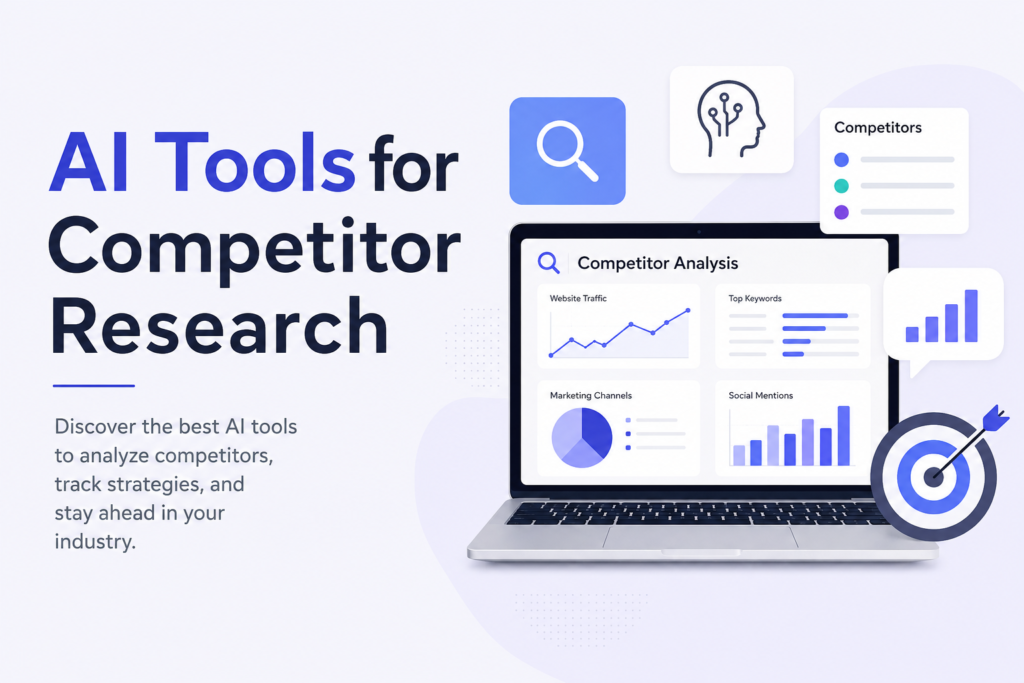
Semrush can be useful for competitor keyword research, traffic analysis, content research, and SEO analysis.
Ahrefs is another popular platform that can help with competitor research, backlinks, keywords, and content opportunities.
Google Search can also be surprisingly useful. I can combine normal searches with AI assistance to understand search results and identify patterns.
ChatGPT can help me analyze information, organize research notes, compare competitors, generate questions, and brainstorm content opportunities.
Other SEO platforms also provide AI powered features for content analysis and keyword research.
For me, the best tool is not necessarily the one with the most features. It is the one that helps me solve my specific research problem without making the process unnecessarily complicated.
How I Use AI Without Copying Competitors
This is very important to me.
Competitor research should not become competitor copying.
If I see that another website has a successful article, I do not want to rewrite the same article with slightly different words. That does not create real value.
Instead, I ask myself why the article is successful.
Does it answer an important question?
Is it easy to understand?
Does it provide examples?
Does it cover a topic better than other websites?
Can I explain the subject from my own experience?
These questions help me create something original.
AI can provide ideas, but my own experience, research, opinions, and examples are what make the final content different.
Mistakes to Avoid When Using AI for Competitor Research
One mistake is trusting every AI generated conclusion.
AI can make mistakes. It may misunderstand data or make assumptions that are not supported by evidence.
That is why I always verify important information.
Another mistake is focusing only on competitors that rank at the top of Google. Smaller websites can also have excellent ideas, unique content, or strong communities.
I also avoid spending too much time collecting data without actually using it.
Research should lead to action.
If I spend hours analyzing competitors but never create content, improve my website, or change my strategy, the research has limited value.
My Final Thoughts
AI tools for competitor research have changed the way I study online competition. They make it easier for me to analyze keywords, content, websites, social media, reviews, and potential opportunities.
The biggest benefit for me is not simply getting information faster. It is being able to look at a large amount of information and turn it into something I can understand and use.
However, I believe AI works best when I stay involved in the process. I do not want AI to decide my entire strategy. I want it to help me think better and work faster.
My approach is simple. I use AI to collect ideas, organize information, find patterns, and identify possible opportunities. Then I verify the important information and use my own judgment to decide what to do.
Competitor research is not about becoming a copy of someone else. It is about understanding the market so I can find my own place in it.
If I use AI correctly, I can spend less time doing repetitive research and more time creating useful content, improving my website, and building something that gives people a reason to come back.